
- Never let real estate agents treat your invoice as an escrow line-item; your bills are due upon receipt.
- A clear home inspector late fee policy sets professional boundaries and keeps your accounts receivable healthy.
- Use our free late fee calculator to compute overdue interest automatically without doing complex mental math in your truck.
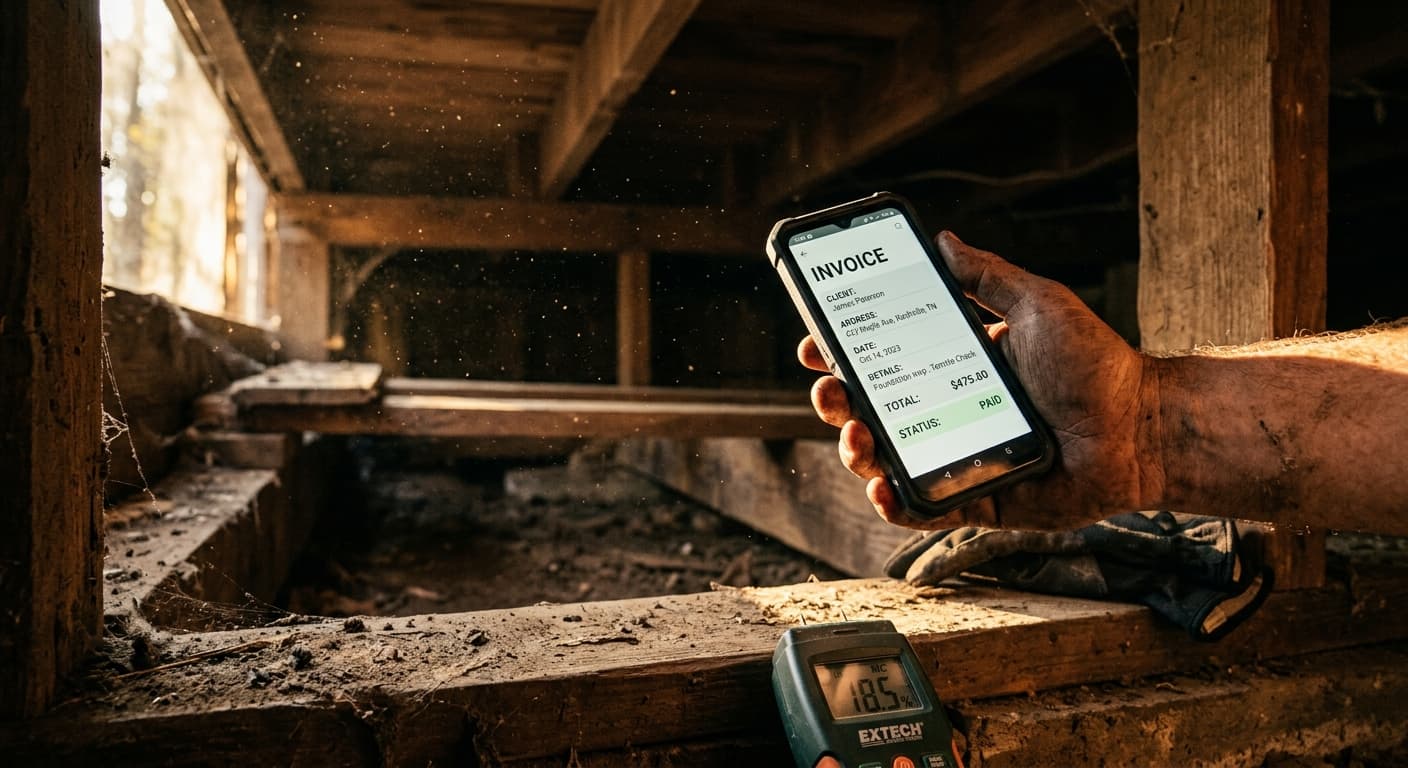
It was mid-August in Nashville. If you have never been to Tennessee in August, imagine standing inside a wet wool sock that someone placed inside a hot oven. I was squeezed into a tight crawlspace access under a 1920s craftsman home in East Nashville. I had my headlamp on, a trusty moisture meter in my back pocket, and active termite inspection mud tubes staring me right in the face. My knees were sinking into the damp soil as I noted some pretty serious foundation cracks near the chimney base.
By the time I crawled out, set up the radon test monitors, completed the HVAC evaluation, and opened up the rusted electrical panel, I was absolutely dripping sweat. I sat in my truck, turned the AC to max, compiled my report findings, and emailed the invoice to the buyer's agent. Ten minutes later, my phone buzzed. "Hey Angela, great report! Can we just pay this out of escrow at closing next month?"
I sighed. In my 15 years as an inspector, I have heard this exact phrase hundreds of times. Realtors love to suggest paying at closing because it makes the transaction feel seamless for their clients. But here is the cold, hard truth: a real estate closing is not a guaranteed payment gateway. Deals fall through constantly. When a buyer backs out because of my roof condition findings or a bad plumbing assessment, guess who gets left holding the bag? You do. Your cash flow takes a massive hit, your overhead costs keep piling up, and suddenly you are spending valuable billable hours acting as a collection agency.
The Real Estate Escrow Trap: Why Waiting for Closing Kills Cash Flow
When you agree to wait for closing to get paid, you are essentially giving an interest-free loan to a stranger. You have already done the work. You burned your fuel, squeezed your body through tight crawlspace access points, and spent your evening writing up detailed report findings. Your business expenses do not wait for closing. Your truck payment, your general liability insurance, and your software subscriptions are due every single month.Let's look at the math. If you do three inspections a week at $450 each, and all of them wait 45 days for escrow to close, you have over $5,000 sitting in accounts receivable. That is money you cannot use to buy new gear, run marketing campaigns, or even pay yourself. Plus, if the deal falls apart because of a structural issue or a failed negotiation, the buyer has very little incentive to pay you. They are already frustrated about losing the house; they do not want to pay $450 for a report on a home they will never own.
Pro Tip: Never release the final written report findings until the invoice is paid in full. Once the buyer and their agent have the report in hand, you lose 90% of your use to collect.
How to Establish a Solid Home Inspector Late Fee Policy
You need to set expectations before you ever step foot on the property. A professional home inspector late fee policy is not greedy; it is standard business practice. Your terms should state clearly that payment is due upon receipt, or at the very latest, within Net 30 terms if you are doing commercial work or high-volume inspections for investment groups.
To protect your margins, your policy should include a flat late fee (like $25) or a monthly interest charge (like 1.5% to 2% per month) on all outstanding invoices. This encourages prompt payment and covers the administrative cost of chasing down late clients. If you do not have these terms in writing, you cannot legally enforce them later when a client decides to ignore your emails.
How do you set this up legally? We highly recommend using our free Service Agreement Generator to draft a contract that includes your exact payment terms and late fee policies. Getting a digital signature on this contract before you start your radon test or climb onto the roof ensures everyone is on the same page from day one.
Enforcing Your Policy with a Late Fee Calculator
When an invoice actually goes past due, calculating interest manually is a giant pain. Nobody wants to sit down with a calculator, figure out the exact number of days overdue, and do percentage math on a $450 bill. It makes you look disorganized, and it wastes time that you could spend doing another termite inspection.
This is where a specialized tool makes life easy. Our free Late Fee Calculator does all the heavy lifting for you. You just enter the original invoice amount, the due date, and your interest rate, and it spits out the exact amount to charge on your revised bill. It keeps your accounts receivable clean and professional.
Templates and manual calculators are fantastic when you are sitting at a desk. But let's be honest for a second. When you are standing in a customer's driveway with mud on your boots and grease on your fingers, trying to type numbers into a spreadsheet on a cracked phone screen is a nightmare. If you want to skip the typing entirely, you should be using VoiceInvoice. You can literally just speak your invoice details while packing up your ladders, and our tool generates a professional PDF with your terms built right in. If you just need a quick, manual bill on the go, you can also use our Free Invoice Generator to get it sent before you even start your truck.
How This Compares to Other Trades and Tools
While a plumber or an electrician can physically remove a part or turn off a breaker if they do not get paid, home inspectors deal in information. Once the report findings are delivered, our work cannot be undone. Unlike a landscaper who has recurring monthly billing, or an HVAC technician who installs physical equipment, our transactions are often one-off events. This makes a strict upfront policy even more critical for us than it is for other field service operators.
Many inspectors try to manage this using massive field service platforms like Housecall Pro or Jobber. But those platforms are bloated and expensive, costing upwards of $150 a month for features a solo inspector will never use. Other guys try cheap apps like Invoice Simple, but they often get hit with bait-and-switch pricing and find it impossible to cancel. Some stick to Excel templates, which are free but require tedious pinching and zooming on your phone screen in a dark crawlspace. VoiceInvoice offers a simple, voice-first alternative that lets you bill instantly from the field without the high monthly overhead.
Pro Tip: Always blame the system. If an agent asks you to waive a late fee, say, "My invoicing platform automatically applies late fees after 15 days, and I can't override it without locking up my accounting software." This keeps you from looking like the bad guy.
Step-by-Step Guide to Automating Your Billing and Late Fees
- Get the Agreement Signed First: Use a contract generator to establish your payment terms before the inspection date.
- Invoice Immediately on Site: Do not wait until Friday night. Speak your invoice into VoiceInvoice while standing by your truck.
- Set Clear Terms: State clearly on the invoice: "Payment due upon receipt to release report findings."
- Apply the Late Fee: If they pass your grace period, use the late fee calculator and send a revised invoice with the updated total.
The Verdict: Professionalism Pays
At the end of the day, running a successful home inspection business is about respect. Respect for your time, your expertise, and your physical labor. When you let clients and agents push payments off to closing, you are letting them run your business. Establishing a clear home inspector late fee policy, backed by professional invoicing tools, ensures you get paid for every single crawlspace you squeeze into.
— Angela Marsh, Home Inspector, Nashville, TN. ASHI-certified home inspector. Does 3-4 inspections a day. Used to invoice from the kitchen counter at 9pm. Not anymore.